
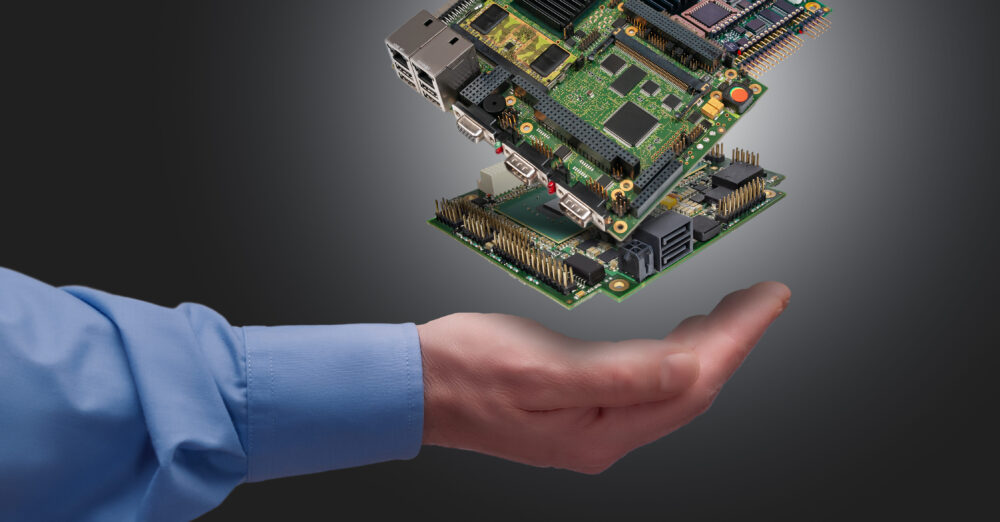
Embedded Systems: The Backbone of Modern Electronics
Today, electronic intelligence is found in virtually every technical product. Whether it’s a household appliance, industrial equipment, a vehicle, or a medical device: Inside, there is usually a specialized computer system performing a clearly defined task. Such systems are referred to as embedded systems. . We explain how embedded systems are structured, which key components they include, and in which applications they play a pivotal role.
Table of contents
- What is an embedded system?
- How does an embedded system work?
- What components make up an embedded system?
- Key Components in the System Context
- Where are embedded systems typically used?
- What requirements must embedded systems meet?
- What challenges exist in the design process?
- Thinking About and Implementing Embedded Systems Holistically
What is an embedded system?
An embedded system is a specialized computer system integrated into a larger product that performs a clearly defined function.
Unlike a traditional PC or server, an embedded system is not universally applicable but is optimized for a specific application. It often operates in the background without a direct user interface and is designed for reliability, efficiency, and stability.
Typical characteristics of an embedded system are:
- specialized function rather than universal use
- integration into a higher-level system
- often resource-optimized or application-specific in design
- high degree of optimization
- often real-time capable
Good to know: A microcontroller alone does not constitute a complete embedded system, but it often forms its core. Only the interaction of hardware, peripherals, and software results in the complete system.
How does an embedded system work?
An embedded system processes inputs from its environment, makes decisions based on programmed logic, and subsequently controls defined outputs. Sensors detect physical quantities such as temperature, pressure, or motion and convert them into electrical signals. The processing unit processes these signals using the embedded software.
Depending on the calculated results, actuators are controlled, such as motors, valves, or displays. This process occurs continuously or event-driven, and in many applications, within fixed time constraints. This creates a closed-loop control system that monitors, influences, or automates physical processes.
What components make up an embedded system?
An embedded system consists of several functional building blocks that together perform a clearly defined task. Regardless of complexity or application area, the following components form the technical foundation:
Processing unit
This can consist of:
- a microcontroller (MCU)
- a microprocessor (MPU)
- a system-on-chip (SoC)
Microcontrollers often integrate memory and peripherals onto a single chip and are suitable for compact, energy-efficient applications. Microprocessors are used when higher computing power or complex operating systems are required.
Learn more about the selection of the right microcontroller
Memory
An embedded system typically requires:
- Flash memory for program code
- RAM for temporary data
- EEPROM or non-volatile memory for persistent parameters, if necessary
Sizing is application-specific.
Interfaces and Peripherals
Depending on the requirements, various interfaces are used to communicate with external components, such as:
- GPIO
- ADC and DAC
- I²C
- SPI
- UART
- CAN
- Ethernet
Power Supply
A stable and optimized power supply is essential. Typical components include: DC/DC converters
- Voltage regulators
- DC/DC converters
- Power management ICs
- Battery management solutions
Software
The software controls the interaction of all components and can be implemented as:
- Bare-metal application without an operating system
- Real-time operating system (RTOS)
- Embedded Linux
Key Components in the System Context
In addition to the structural design, the specific system configuration of embedded systems determines how the components interact.
Sensors and Actuators
Sensors measure physical quantities such as temperature, pressure, or acceleration. Actuators convert calculated signals into mechanical or electrical actions. The embedded system handles evaluation, decision logic, and control, often as a closed-loop control system.
Communication Modules
Networked embedded systems integrate additional communication components. These enable wireless transmission via Wi-Fi or Bluetooth, as well as industrial bus systems or Ethernet-based protocols. This makes embedded systems components of higher-level infrastructures or IoT architectures.
Power Electronics
In applications involving higher currents or voltages, the embedded system controls power semiconductors such as MOSFETs or IGBTs via corresponding driver stages. This allows for the precise control of motors, heating systems, or industrial actuators.
Where are embedded systems typically used?
Embedded systems can be found in almost every technical field. In the Internet of Things (IoT), embedded systems serve as the link between the physical world and digital infrastructure. In industrial production facilities, they control motors, sensor systems, or conveyor technology. In the automotive sector, numerous vehicles contain embedded systems, for example in engine control units or driver assistance systems.
Embedded systems are also increasingly used in medical technology as well as in consumer and household appliances, for example in diagnostic devices and infusion pumps or in washing machines and smart home components.
What requirements must embedded systems meet?
Embedded systems are now an integral part of complex architectures. Accordingly, expectations regarding safety and system stability are rising. In industrial and safety-critical applications, for example, reliability, long-term availability, and deterministic timing behavior are paramount. In consumer or IoT devices, on the other hand, energy efficiency and cost optimization often take precedence.
Real-time capability also plays a central role. Many systems control physical processes where response times must be precisely defined. In addition, EMC immunity, thermal stability, and mechanical robustness are essential criteria. In networked systems, requirements for IT security and secure communication are added.
What challenges exist in the design process?
The development of an embedded system requires close integration of hardware and software.
Key challenges include:
- Hardware-software co-design
- Power supply architecture
- Thermal design
- Debugging and validation
- Certification requirements
Wrong decisions in early design phases can make later adjustments considerably more difficult. A careful selection of semiconductors, peripherals, and power components is therefore crucial.

1. Requirement definition
2. Hardware selection
3. Software architecture
4. Prototyping
5. Validation and testing
6. Production release
Thinking About and Implementing Embedded Systems Holistically
Embedded systems form the technological foundation of modern electronics. They control machines, regulate processes, network devices, and enable intelligent functions in virtually every industry. However, their performance depends crucially on the careful selection and integration of all components.
For developers and technical buyers, this means viewing components not in isolation, but within the context of the system. Because: A structured systems approach reduces risks, shortens development times, and provides long-term planning security.
Bürklin offers not only a comprehensive portfolio of microcontrollers and power semiconductors, but also transparency regarding product availability and lifecycle status—an important foundation for stable and sustainable embedded designs.
This might also interest you
-

Energy efficiency
Committed to the Climate: Energy Efficiency Act (EnEfG)
The Energy Efficiency Act (EnEfG) has been in force since November 2023 and obliges authorities, companies and data centers to take energy measures. What does the Energy Efficiency Act actually stipulate? And what strate...
-
Energy efficiency
Light with precision: RGB LEDs with integrated control circuit
Additive color mixing with red, green and blue LEDs, grouped into pixels, opened up new possibilities for displays and lighting designs. When the first modules with integrated circuits (ICs) appeared around ten years ago...
-
Measurement technology
Understanding Power Management ICs: Key Components of Modern Electronics
Efficiently distributing, regulating, and monitoring power is one of the central tasks of electronic systems today. Power density, feature sets, and reliability requirements are constantly increasing. At the same time, p...