
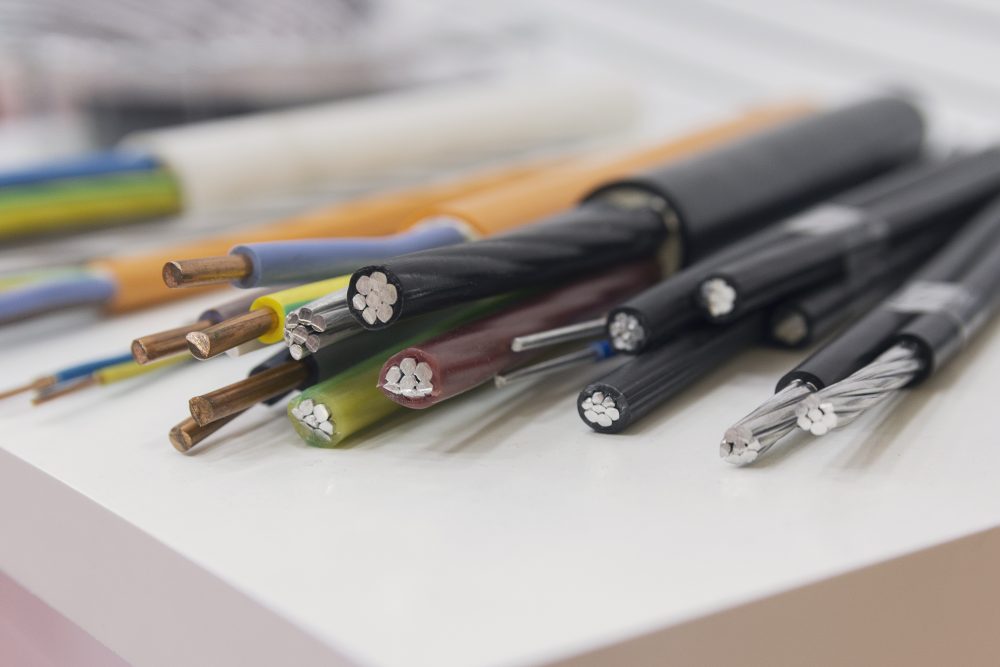
Cables and Wires: Functions and Applications
Cables and wires play a central role in electrical and electronic systems: They reliably transmit power, data, and control signals from one point to another. Their functions and applications are diverse—but which cables are suitable for which purpose? And how can the type designations be correctly interpreted? This article provides an overview of cable types by function and application as well as the cable type code for harmonized and nationally recognized cables.
Table of contents
- Cables and Wires in Demanding Conditions
- What types of cables are there?
- Cable Types by Function
- Cable types by application
- Cable Type Code: Harmonized and Nationally Recognized Cables
- Which cables are suitable for which applications?
- Where are control cables used?
- Common mistakes in cable selection
- Systematic Cable Selection
- Frequently Asked Questions About Cables and Wires
Cables and Wires in Demanding Conditions
Cables and wires must withstand increasingly difficult external conditions. The demands on jacket materials, insulation, shielding, and conductors are continuously rising. Depending on the application, the individual components are specifically optimized to withstand mechanical, thermal, and chemical stresses.
Key requirements include:
- Performance at smaller bending radii
- Increased temperature resistance
- Improved UV protection
- Protection against oil, moisture, and chemicals
- EMC protection to prevent electromagnetic interference
Especially in industrial applications, these properties determine the operational safety and service life of a system.
What types of cables are there?
Before installation, it must be determined what purpose a cable serves and in what environment it will be used. The appropriate cable type is determined accordingly by the design and material requirements.
Cable Types by Function
- Power cables: single- or multi-conductor cables for transmitting electrical power
- Data cables: for transmitting electrical or optical signals representing digital information in communication and network technology (e.g., twisted-pair, coaxial, or fiber-optic cables)
- Control cables: for transmitting switching states and control signals in machines and systems
- Signal and communication cables: for transmitting modulated signals in various frequency ranges
- Combination or hybrid cables: combine power and data transmission within a single cable – for example, in automated production systems
Depending on the type, different functions can be fulfilled. Modern data cables increase network transmission rates, while power cables ensure the supply of power grids. High-performance control cables guarantee reliable signal transmission even under demanding environmental conditions.
Cable types by application
In addition to function, the application plays a decisive role in the selection.
- Underground cables: Robust cables for outdoor power supply with reinforced jacket construction. They are approved for direct burial in accordance with relevant VDE standards and designed to withstand mechanical stress and moisture.
- Heat- and cold-resistant cables: special cables for use in environments with highly fluctuating or extreme temperatures, such as industrial facilities or cold storage areas
- Offshore and specialty cables: Cables for particularly demanding environments such as offshore installations or maritime applications. They meet specific standards and requirements regarding resistance to oil, mud, and salt water.
In many installations, especially where devices are located in close proximity, effective EMC protection is also required. Shielded cables reduce the coupling and radiation of electromagnetic interference, thereby contributing to stable signal transmission. However, the complete avoidance of electromagnetic interference depends on the system.
Cable Type Code: Harmonized and Nationally Recognized Cables
National and internationally harmonized designations exist for insulated cables to ensure unambiguous identification. The type designation provides information on load capacity, material, and construction and helps prevent misuse.
The type abbreviation consists of several coding elements:
- Type: “H” stands for harmonized cables according to HAR; “A” denotes national versions based on harmonized standards. However, not all national cables bear the letter “A” (e.g., NYM cables according to VDE).
- B Rated voltage: “03” (300/300 V), “05” (300/500 V), “07” (450/750 V)
- Insulation and sheathing materials: For example, PVC (V), natural or synthetic rubber (R), chloroprene (N), silicone (S), or polyurethane (Q). These materials determine, among other things, temperature resistance, UV protection, and oil resistance.
- Cable type: indicates design and divisibility
- Conductor type: single-strand (U), multi-strand (R), fine-strand (F), or ultra-fine-strand (H)
- Number of conductors and protective conductor: “G” indicates the presence of a protective conductor; “X” means without a protective conductor.
- Conductor cross-section: Specified in square millimeters
Example: Cable designation for an H07RN-F3G1.5 cable from the manufacturer Nexans
This is a harmonized cable with a rated voltage of 450/750 volts. The sheath is made of chloroprene rubber, and the conductor insulation is made of a natural-synthetic rubber blend. In addition, the cable is fine-stranded and flexible, consisting of three conductors. The cable is equipped with a protective conductor, and the cross-sectional area is 1.5 square millimeters.

Which cables are suitable for which applications?
The choice of the right cable depends largely on mechanical stress, temperature range, and environmental conditions:
- Rubber-sheathed cables marked H05RN-F are designed for applications with lower mechanical stress. This includes the connection of electrical devices (e.g., soldering irons or alarm systems) indoors.
- H07RN-F rubber-sheathed cables are classified as heavy-duty rubber-sheathed cables and are suitable for high mechanical stress in both indoor and outdoor environments, such as on construction sites or in industrial settings.
H05RN-F vs. H07RN-F
Both cable types belong to the harmonized rubber-sheathed cables according to HAR. Nevertheless, they differ significantly in terms of load capacity and application range.
| Feature | H05RN-F | H07RN-F |
| Rated voltage | 300/500 V | 450/750 V |
| Mechanical stress | light to medium load | mechanical stress |
| Typical application range | Household appliances, hand tools, indoor use | Construction sites, industrial facilities, outdoor use |
| Flexibility | Flexible (fine-stranded) | Flexible (fine-stranded) |
| Weather resistance | Conditionally suitable | Very well suited |
| Outdoor use | Limited | suitable |
| Permissible environment | Dry and damp rooms | Dry, damp, and wet rooms as well as outdoor use |
Decision guide:
- For light indoor use: H05RN-F
Suitable for appliance connections in dry or damp rooms with low to moderate mechanical stress, such as for hand tools or small electrical appliances. - For construction sites or outdoor use: H07RN-F
Recommended for high mechanical stress, exposure to the elements, or demanding industrial environments. The heavy-duty rubber-sheathed cable is designed to be more robust and is suitable for outdoor use.
Where are control cables used?
Control cables are primarily used in production facilities and automated systems. As the complexity of industrial facilities increases, so do the demands on flexibility and durability.
Under high mechanical or thermal stress, damage to the jacket may occur. This can lead to wire breaks or so-called “corkscrew” deformations, a form of overload caused by repeated bending in which the cable deforms into a spiral shape.
Typical control cable types in production facilities include:
- fine-strand sensor-actuator cables for flexible connections
- PVC- or PUR-insulated control cables (e.g., LiYY, LiYCY, or industrial ÖLFLEX types)
- shielded and halogen-free control cables for demanding industrial environments
- rubber-sheathed cables suitable for increased mechanical stress, such as H07RN-F, in power or connection applications
In traditional machine control systems, specially designed control cables with defined stranding and shielding concepts are frequently used, while H07RN-F primarily serves as a robust connection or power supply cable.
Common mistakes in cable selection
Choosing the wrong cable can significantly compromise operational safety. Common planning and installation errors include:
1. Incorrect rated voltage
A cable with too low a rated voltage can lead to overheating or insulation damage. The voltage rating (e.g., 300/500 V or 450/750 V) must be suitable for the system.
2. Underestimated mechanical stress
Cables without sufficient mechanical strength may fail prematurely due to movement, tensile stress, or bending.
3. Lack of EMC consideration
Unshielded cables in environments prone to interference can cause signal problems. Control and data cables should be shielded if necessary.
4. Inappropriate temperature range
If the permissible temperature range is exceeded, the insulation may become brittle or deform. The manufacturer’s specifications must be strictly observed.
5. Incorrect cable for dynamic applications
Standard cables are not automatically suitable for drag chains or torsion. For moving applications, cable types specifically approved for such use must be used.
6. Protection class and environmental conditions not considered
Oil, chemicals, UV radiation, or moisture require suitable jacket materials such as PUR or special rubber compounds.
Practical recommendation: In addition to electrical parameters, mechanical stress, environmental conditions, and standard requirements should always be taken into account during selection.
Systematic Cable Selection
Cables and wires significantly influence the performance, safety, and service life of electrical systems. The correct selection tailored to function, location, and mechanical and thermal loads is therefore crucial for reliable operation.
Clear type designation and in-depth knowledge of materials and operating conditions help prevent misuse and ensure long-term, stable system operation.
Bürklin supports you with a broad portfolio of cables and wires from leading manufacturers – ranging from standard installation wires to specialized industrial and control cables. If you have any uncertainties, our technical advisors will be happy to assist you in selecting the right cable.
Frequently Asked Questions About Cables and Wires
What is the difference between a cable and a wire?
In common parlance, the terms are often used interchangeably. From a technical perspective, a wire, as defined by DIN VDE, is a generic term for insulated conductors with or without additional protective sheathing for power or signal transmission. In common parlance, a cable is frequently used to refer to multi-conductor, mechanically reinforced conductors particularly for underground installation (e.g., NYY). However, there is no universally accepted, strictly defined distinction in standards; cables are also considered conductors in a technical sense. The specific designation is determined by the applicable standards.
Why is the correct selection of cables so important?
An incorrectly selected cable can lead to overheating, signal loss, mechanical damage, or even the failure of entire systems. The selection should therefore always be made taking into account voltage, temperature range, mechanical stress, and environmental conditions.
When is a shielded cable necessary?
Shielded cables are used when electromagnetic interference (EMI) must be prevented. This is particularly important for control and data cables in industrial plants or in installations where cables are located in close proximity to one another. The shielding reduces the coupling or radiation of electromagnetic interference and thus contributes to operational safety.
Which cable is suitable for moving applications?
For moving applications such as in machines, robotics, or drag chains flexible cables with fine-stranded conductors are used. These are designed for frequent bending movements and withstand continuous mechanical stress.
This might also interest you
-
Energy efficiency
Light with precision: RGB LEDs with integrated control circuit
Additive color mixing with red, green and blue LEDs, grouped into pixels, opened up new possibilities for displays and lighting designs. When the first modules with integrated circuits (ICs) appeared around ten years ago...
-
Measurement technology
Understanding Power Management ICs: Key Components of Modern Electronics
Efficiently distributing, regulating, and monitoring power is one of the central tasks of electronic systems today. Power density, feature sets, and reliability requirements are constantly increasing. At the same time, p...
-

Maintenance
Power Supply in the Control Cabinet: Selection, Sizing, and Fuse Protection
A stable power supply is the backbone of every industrial facility. The control cabinet is where power distribution, control systems, and protective mechanisms converge. It is here that the reliability of control systems...