
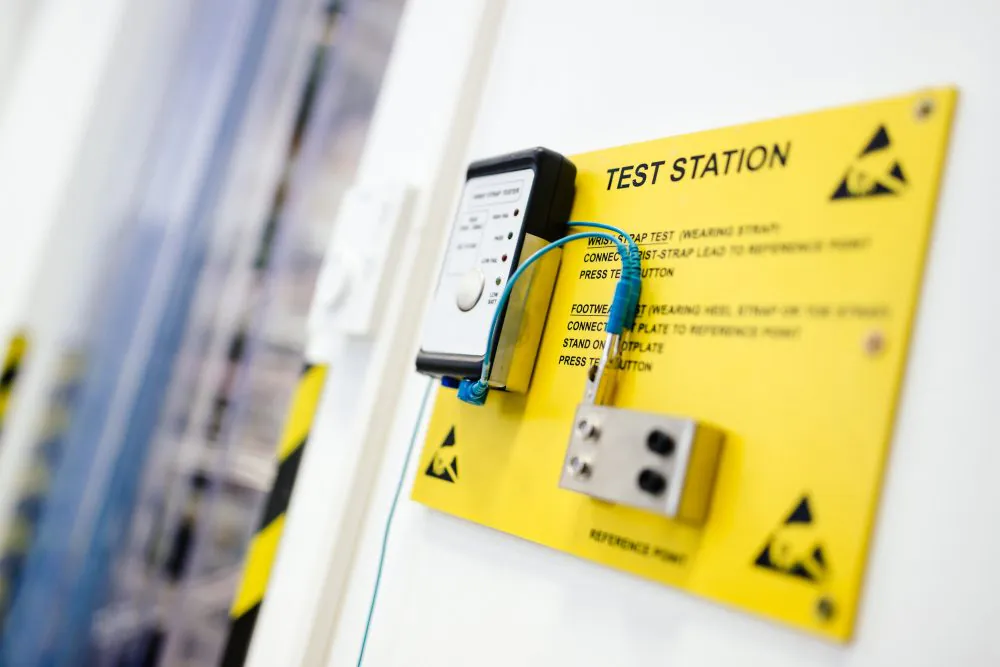
ESD Protection in Action: Measures, Standards, and Requirements
To prevent electronic components from being damaged by electrostatic discharges, targeted ESD protection measures are necessary in the workplace. But which measures are really effective? This article provides an overview of the fundamentals, risks, and appropriate measures, and demonstrates how an effective protection concept can be systematically implemented.
Electrostatic discharges (ESD for short) are among the invisible risks in electronics manufacturing. They are usually neither perceptible nor visible, but can damage sensitive components or even render them unusable. Especially in modern production environments with increasingly smaller and more powerful components, sensitivity to ESD is continuously rising.
Accordingly, the approach to this issue has also evolved. ESD protection is no longer limited solely to the workplace. Rather, it involves a holistic concept that encompasses processes, work environments, and the handling of components throughout the entire value chain—from manufacturing and storage to transportation and service.
Table of contents
- What is ESD?
- What risks does ESD pose?
- Where ESD protection is necessary
- Which standards and requirements apply
- The Most Important Measures in the EPA
- Quick-deployment solutions for smaller ESD protection zones
- ESD protection during storage, transport, and packaging
- Test stations and ionizers
- Training, Audits, and Continuous Improvement
- Systematically Implementing ESD Protection
What is ESD?
Electrostatic discharge (ESD) refers to the sudden equalization of electrical charges between two differently charged bodies. Such discharges occur frequently in everyday life, for example when walking on carpeted floors, when removing synthetic clothing, or when coming into contact with conductive surfaces.
In the process, an object becomes electrostatically charged, for example through friction or the separation of materials. This charge spreads across the entire surface and discharges abruptly as soon as conductive contact or grounding occurs.
While such effects are generally harmless in everyday life, they pose a significant risk in electronics manufacturing. This is because many components are sensitive to even very low voltages—often far below the human perception threshold.
Electrostatic charging is exacerbated by low humidity. A relative humidity of about 40 to 60 percent can help reduce charging.
What risks does ESD pose?
For electronic components, an electrostatic discharge can have serious consequences. The damage is not always immediately visible. In addition to direct defects that lead to component failure, so-called latent damage frequently occurs. While this initially has little impact on function, it shortens the component’s lifespan or leads to failures in the field later on.
The consequences for companies can be significant:
- Quality issues and increased failure rates
- Time-consuming troubleshooting and rework
- Production delays
- Rising costs due to scrap and customer complaints
- Damage to reputation due to unreliable products
Precisely because much of the damage is not immediately apparent, consistent ESD protection is crucial. Instead of merely reacting to visible problems, the goal is to minimize risks from the outset.
Where ESD protection is necessary
ESD protection measures are required wherever sensitive electronic components are handled. This includes not only traditional manufacturing environments but also a wide range of other areas throughout the product lifecycle.
ESD protection is particularly relevant in:
- Electronics manufacturing and assembly
- Laboratories and development departments
- Quality inspection and test environments
- Warehouse and logistics areas
- Service, maintenance, and repair
- Transport and packaging
This shows that ESD protection is not limited to the workplace. What is crucial is consistent protection throughout all stages where components are handled.
Which standards and requirements apply
The central basis for ESD protection measures is the standard DIN EN IEC 61340-5-1. It defines requirements for protecting electronic components from electrostatic phenomena and serves as a guide for companies in establishing an effective ESD protection system.
Among other things, the standard describes how so-called ESD protection zones (EPA – Electrostatic Protected Areas) must be established and operated so that electrostatically sensitive components can be handled safely.
Key elements include:
- suitable work environments and materials
- controlled dissipation of electrostatic charges
- defined rules of conduct for employees
- regular testing and monitoring measures
This shifts the focus from individual protective measures to a comprehensive control program.
Important: In practice, it is recommended to regularly review existing ESD concepts and adapt them to the current version of the standard. With the revised version of DIN EN IEC 61340-5-1:2025-06, for example, stricter testing and documentation requirements as well as a stronger practical orientation in test procedures come into focus.
The Most Important Measures in the EPA
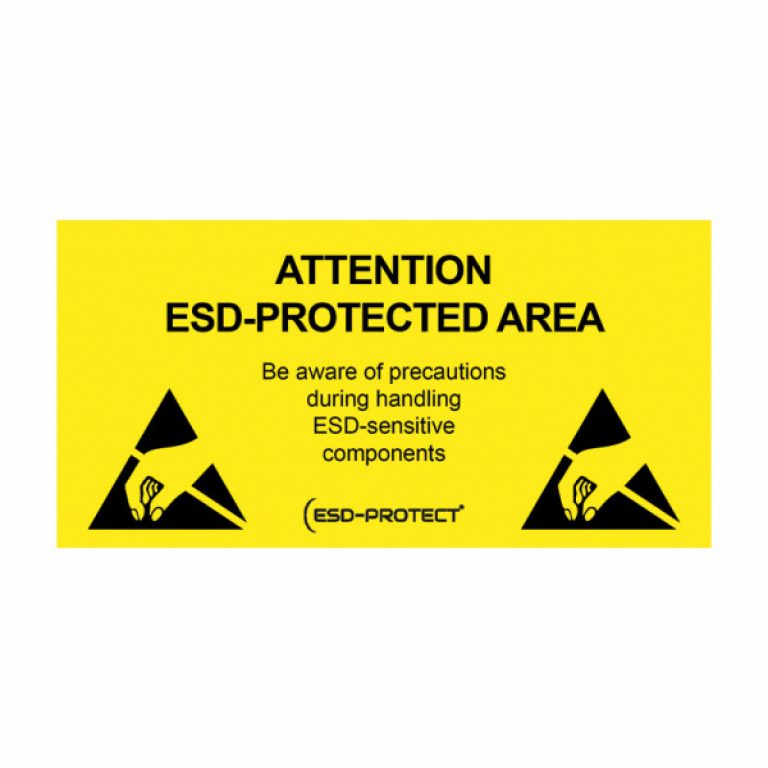
Electronic components should be handled exclusively within an ESD protection area (EPA). Only there can it be ensured that electrostatic charges are dissipated in a controlled manner and new charges are prevented. For this to work, various measures must be integrated.
Workstation and Environment
An ESD-compliant workstation forms the basis for the safe handling of sensitive components. This includes:
- conductive or antistatic work surfaces
- ESD-compliant furniture and seating
- suitable floor coverings
- avoidance of unnecessary insulators such as plastic parts, adhesive tapes, or Styrofoam
All components within the ESD-protected area (EPA) should be checked for ESD suitability and reduced to the necessary minimum.
Personal Grounding and Access Control
A key factor in ESD protection is the person themselves. Movement or friction can quickly cause the body to become electrostatically charged.
Therefore, measures for controlled dissipation are essential:
- Wrist grounding straps for sedentary work
- Conductive footwear in combination with suitable flooring
- Personnel testers for regular checks of conductivity
Only when these measures are consistently applied can the risk of electrostatic discharge be reliably reduced.
Tools and Equipment
All tools within an ESD-protected area (EPA) should also be ESD-compliant. Conventional materials can store electrostatic charges or transfer them uncontrollably.
Typical ESD tools include:
- Tweezers made of conductive or antistatic material
- ESD screwdrivers
- Special work mats and underlays
- Ionizing devices for neutralizing charges
They ensure that components remain protected even during direct contact and that no uncontrolled discharges occur.
ESD Clothing and Materials
Clothing also plays an important role in ESD protection. Special ESD clothing is made of materials with conductive fibers that prevent or specifically dissipate electrostatic charges.
Important:
- Clothing should always fit snugly and be worn fully closed.
- Underlying clothing must not be visible.
- Materials must comply with current standard requirements.
As standards continue to evolve, greater emphasis is being placed on material requirements.
Quick-deployment solutions for smaller ESD protection zones
Not every application requires a fully equipped ESD environment. Especially in smaller areas, such as assembly or quality assurance, flexible solutions can be useful.
ESD table and floor coverings, for example, offer a practical way to quickly create a protected work environment. They reliably dissipate electrical charges and reduce the risk of damage to sensitive components.
Such solutions are particularly suitable where work is performed on an ad hoc basis or where existing workstations need to be retrofitted.
ESD protection during storage, transport, and packaging
A common weak point in practice: ESD protection ends at the workstation. In reality, however, risks arise throughout the entire process chain. Components must also be protected during the following steps:
- Storage in suitable, conductive containers
- Transport within the company
- Shipping and packaging
- Handling outside traditional production environments
Only when all stages are taken into account is protection maintained consistently. A break in ESD protection can lead to damage even at optimally equipped workstations.
Test stations and ionizers
Regular checks are necessary to ensure effective ESD protection. Test stations help verify the effectiveness of protective measures and ensure that all requirements are met.
Ionizers are used where electrostatic charges cannot be controlled by grounding alone. They neutralize charged particles in the environment, thereby contributing to safety. These technologies are particularly indispensable in sensitive areas where even the smallest discharges can cause damage.
Training, Audits, and Continuous Improvement
Technical measures alone are not sufficient to permanently minimize ESD risks. It is crucial that all parties involved understand the requirements and consistently implement them in their daily work.
Therefore, the following are important:
- regular training for employees
- clear rules of conduct when handling components
- documented processes and work instructions
- continuous review and auditing of the measures
Systematically Implementing ESD Protection
One thing is certain: Effective ESD protection today requires a comprehensive concept that takes into account workstations, processes, as well as storage, transport, and packaging in equal measure. With current regulatory requirements, this holistic approach is becoming increasingly important.
Bürklin supports you with a wide range of ESD products as well as expert advice to find suitable solutions for individual requirements.
This might also interest you
-

Energy efficiency
Committed to the Climate: Energy Efficiency Act (EnEfG)
The Energy Efficiency Act (EnEfG) has been in force since November 2023 and obliges authorities, companies and data centers to take energy measures. What does the Energy Efficiency Act actually stipulate? And what strate...
-

Energy efficiency
Light with precision: RGB LEDs with integrated control circuit
Additive color mixing with red, green and blue LEDs, grouped into pixels, opened up new possibilities for displays and lighting designs. When the first modules with integrated circuits (ICs) appeared around ten years ago...
-

Measurement technology
Understanding Power Management ICs: Key Components of Modern Electronics
Efficiently distributing, regulating, and monitoring power is one of the central tasks of electronic systems today. Power density, feature sets, and reliability requirements are constantly increasing. At the same time, p...