
SMD vs. THT: Differences, Advantages, and Applications
Today, electronic assemblies are becoming increasingly compact, powerful, and complex. At the same time, demands for reliability, manufacturing quality, and repairability are rising. Two soldering technologies dominate this field: Through-Hole Technology (THT) and Surface-Mount Devices (SMD). We explain the differences between SMD and THT and highlight the advantages and disadvantages of both technologies. Plus: a brief, practical introduction to SMD soldering!
Table of contents
How do SMD and THT differ?
The key difference between SMD and THT lies in the method of mounting on the printed circuit board. This fundamental characteristic influences not only the design of the components but also the layout, manufacturing processes, and subsequent applications.
With Through-Hole Technology (THT), electronic components with wire leads are inserted through holes in the PCB and soldered on the underside. The leads are mechanically secured to the board, resulting in high stability. At the same time, however, this technique requires additional holes, which take up space and limit the possible component density.
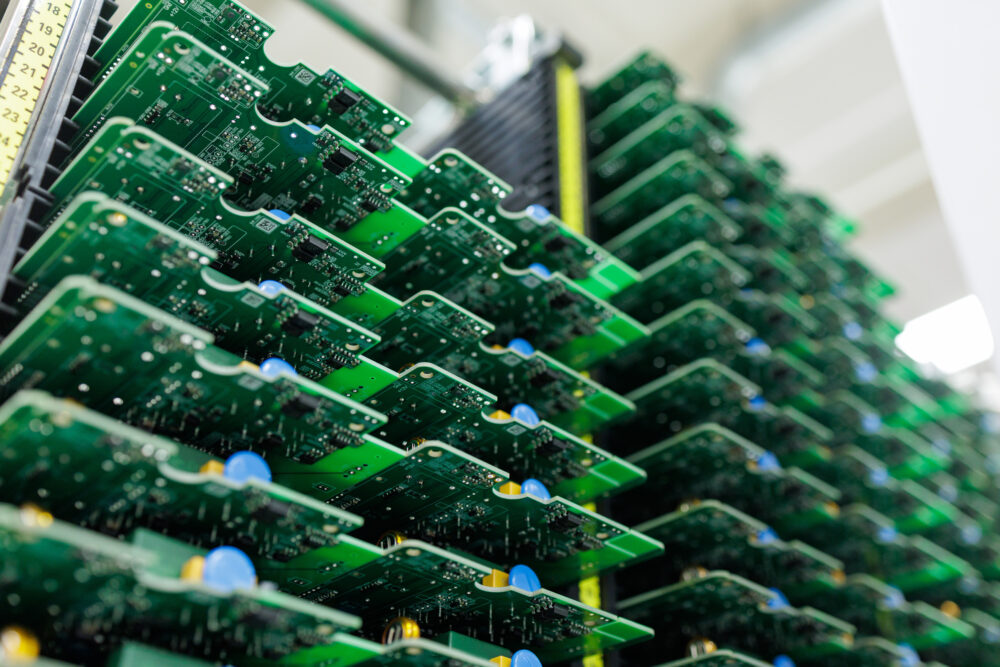
Surface-Mount Devices (SMD), on the other hand, are soldered directly onto the surface of the printed circuit board. The electrical contacts are located as pads or contact areas on the underside or sides of the component. Since no through-holes are necessary, the printed circuit boards can be designed to be significantly more compact in this case and populated on both sides. This is a key reason for the widespread use of SMD in modern electronic assemblies.
SMD vs. THT: Advantages and Disadvantages
So which is better: SMD or THT? Such an assessment falls short in this case, as both technologies pursue different objectives. Accordingly, both SMD and THT have advantages and disadvantages and are suitable for different requirements.
Advantages of SMD
SMD technology enables a very compact design. By eliminating the need for holes, PCBs can be populated more densely, which is particularly crucial for modern electronic products.
Other advantages of SMD:
- high degree of automation in mass production
- lower parasitic effects, especially in high-frequency applications
- reduced material usage in printed circuit boards
- shorter signal paths
SMD is therefore the dominant technology in sectors such as consumer electronics, industrial electronics, and automotive.
Advantages of THT
THT components score points primarily due to their mechanical stability. The wire leads ensure firm anchoring in the PCB, which is advantageous in applications subject to mechanical or thermal stress.
Additional advantages:
- high resistance to insertion and tensile forces
- easy handling during manual assembly
- well-suited for prototypes and repairs
- lower requirements for specialized tools
THT remains indispensable, particularly in power electronics, connectors or transformers.
Where are SMD and THT used in practice?
In industrial practice, SMD and THT are rarely considered in isolation. Often, both technologies are used together.
SMD is typically found in:
- high-volume production
- control and regulation electronics
- communications and high-frequency technology
- compact embedded systems
THT is preferred for:
- Connectors and switches
- Power components
- Components subject to mechanical stress
- Prototypes and small-batch production
So-called mixed assembly combines the advantages of both worlds and is state-of-the-art in many applications.
Decision guide: SMD or THT?
- SMD: when high component density and automated manufacturing are required
- THT: when mechanical stability and ease of repair are the priority
- Mixed assembly: when both requirements are combined
- The application, quantity, and stress on the assembly are decisive
Important: Both soldering techniques require suitable tools and accessories!
SMD Soldering for Beginners: What You Really Need
SMD soldering is often considered challenging. However, with the right equipment and some practice, it is quite manageable even outside of automated production.
Basic Equipment
To get started, a modest selection of tools is sufficient:
- a temperature-controlled soldering station with a fine tip
- high-quality solder
- flux (e.g., in stick or paste form)
- fine-tipped tweezers
- a magnifying glass or a simple microscope
- desoldering braid for corrections
These tools already cover the majority of typical SMD work.
Optional Tools
Depending on your needs and component size, additional equipment may be useful:
- Hot-air station for larger components or repairs
- Preheating plate for even heating
- Stencils for solder paste when working with multiple solder joints
However, this equipment is not a must for beginners.
Step by step: How to succeed at your first SMD soldering
Soldering SMD components requires some practice but follows clear basic principles. With a structured approach, even your first soldering jobs can be carried out in a controlled and reproducible manner.
- Prepare the pad: Lightly pre-tin the solder pad and apply flux.
- Position the component: Align the SMD component precisely with tweezers and secure it in place.
- Solder the first contact: Heat the pre-tinned pad until the component makes clean contact.
- Solder the second contact: Complete the remaining solder joint neatly and inspect it.
- Inspection: Visually inspect for clean wetting and correct positioning.
Good to know: This procedure is particularly suitable for smaller components and individual jobs.
Common Mistakes and How to Avoid Them
Certain mistakes occur repeatedly, especially when first starting out with SMD soldering. Knowing what they are allows you to take targeted countermeasures and significantly improve the quality of the solder joints.
- Too much solder: Quickly leads to short circuits in this area, less is usually more.
- Lack of flux: Without flux, dull or unreliable solder joints result.
- Incorrect temperature: Temperatures that are too low lead to cold solder joints; temperatures that are too high can damage components.
- Movement during cooling: The component should not be moved during cooling.
As always: A steady hand and clean tools are crucial.
Also interesting on the topic of soldering
Two technologies, different strengths
SMD and THT are not competing but complementary technologies. The choice always depends on the application, quantity, mechanical requirements, and manufacturing processes. While SMD impresses with miniaturization and automation, THT scores points for robustness and ease of use.
Those who understand the strengths of both technologies can make informed decisions and create reliable electronic assemblies. At Bürklin, you’ll find a broad, application-oriented range of products from renowned manufacturers for both soldering techniques, supporting both industrial requirements and practical development and repair tasks.
This might also interest you
-
Energy efficiency
Light with precision: RGB LEDs with integrated control circuit
Additive color mixing with red, green and blue LEDs, grouped into pixels, opened up new possibilities for displays and lighting designs. When the first modules with integrated circuits (ICs) appeared around ten years ago...
-

Measurement technology
Understanding Power Management ICs: Key Components of Modern Electronics
Efficiently distributing, regulating, and monitoring power is one of the central tasks of electronic systems today. Power density, feature sets, and reliability requirements are constantly increasing. At the same time, p...
-

Maintenance
Power Supply in the Control Cabinet: Selection, Sizing, and Fuse Protection
A stable power supply is the backbone of every industrial facility. The control cabinet is where power distribution, control systems, and protective mechanisms converge. It is here that the reliability of control systems...