
Soldering Technology in Manufacturing: From Manual Soldering Stations to Reflow Systems
Hand soldering, selective soldering, wave soldering, or reflow soldering: In practice, several soldering processes are often used in parallel today – within the same company, sometimes even on the same line. This is because what works perfectly in prototype construction can quickly lead to bottlenecks in series production. In addition, highly automated processes are not always the best solution for every assembly. This article provides a structured overview of common soldering techniques and offers decision-making aids for selection in practice.
Table of contents
- Why soldering technology is so diverse today
- Manual soldering stations: the classic in manufacturing
- Selective soldering and wave soldering: The bridge between manual work and automation
- Reflow soldering: Standard in SMD series production
- Comparison: Which soldering technique is suitable for which application?
- Deciding: Questions to ask yourself
- Soldering technology as a process decision
Why soldering technology is so diverse today
There is a simple reason why there are so many soldering processes today: the requirements in manufacturing have changed significantly.
- Components are getting smaller
- Assemblies are becoming more complex
- Quality requirements are increasing
- Cost and time pressures are increasing
- Flexibility is a must
Manual soldering stations: the classic in manufacturing
Manual soldering stations are often the first point of contact with professional soldering technology – and they are not disappearing from modern manufacturing facilities. On the contrary: Manual soldering stations remain relevant because there are always tasks that are difficult to automate.
Typical areas of application for manual soldering
- Prototype construction and development
- Rework and repair
- THT components in small series
- Cable assembly
- Special assemblies, variant production, small quantities
What makes a good manual soldering station?
A good manual soldering station consists of more than just a soldering iron and solder. The key is a setup that makes quality reproducible while remaining efficient.
Important components:
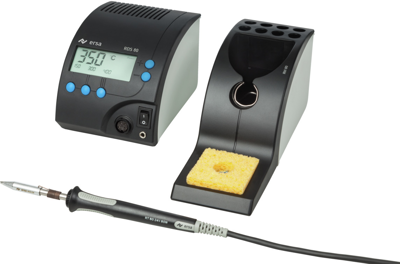
- Soldering station with temperature control
- Suitable soldering tips
- Tweezers and gripping aids for precise positioning
- ESD protection (mat, wrist strap, grounded tools)
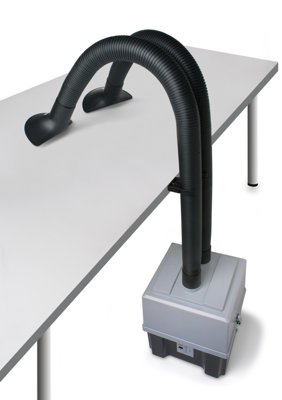
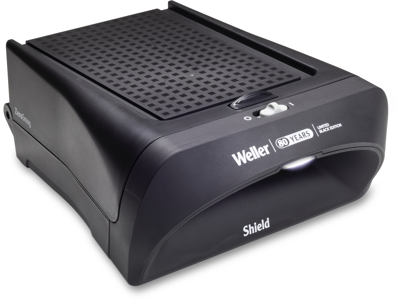
- Solder fume extraction and workplace protection
Would you like to learn more about ESD protection in the workplace? We have summarized the most important information for you: Read the article


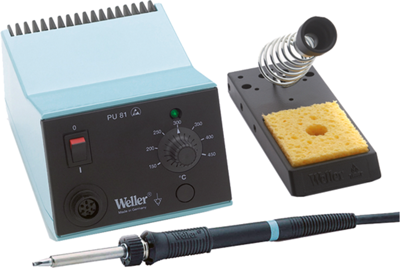
Manual soldering: Advantages and limitations
Manual soldering is ideal for beginners. However, stable series processes often require supplementary or automated procedures.
Advantages
- Very flexible, quick to use
- Low investment costs
- Ideal for individual pieces and adjustments
Disadvantages
- Highly dependent on experience and daily form
- Quality fluctuates without clear process specifications
- Quickly becomes inefficient as quantities increase
- Risk of thermal overload (components/PCB)
Selective soldering and wave soldering: The bridge between manual work and automation
As quantities increase, a purely manual soldering process is often no longer sufficient. The challenge: higher throughput and consistent quality without losing flexibility. This is where processes such as selective and wave soldering come into play. In many manufacturing operations, they represent the next stage of expansion, as they offer more stable processes and more predictable cycle times with less manual work.
Wave soldering: fast, robust, but less flexible
Wave soldering is an automated soldering process that is mainly used for THT components (through-hole technology). In this process, the printed circuit board runs over a wave of liquid solder. This solder wave wets the through-hole pins and pads on the underside, while the solder also rises into the through-hole via capillary action.
Strengths
- High speed
- Proven technology for series production
- Economical for suitable assemblies
Challenges
- Less suitable for complex mixed-tech assemblies
- Masking/covering may be necessary
- Solder bridges and shadow effects possibl
Wave soldering works particularly well when …
- many THT pins need to be soldered.
- the assemblies are standardized.
- the process is to run stably over long series.
Selective soldering: automated – but targeted
In selective soldering, only certain solder joints on a printed circuit board are soldered, usually THT pins or individual areas of an assembly. In contrast to wave soldering, the solder is therefore only applied where it is needed.
Strengths
- Good repeatability
- Often less thermal stress
- Ideal for more complex assemblies
Challenges
- Programming/setup requires expertise
- Process window must be clearly defined
- Not every geometry is trivial (distances, shadowing)
Selective soldering works particularly well when …
- only certain areas need to be soldered.
- the assembly has sensitive SMD zones.
- mixed technology is used.
Reflow soldering: Standard in SMD series production
When it comes to modern electronics manufacturing, there is hardly any way around reflow soldering, especially for SMD assembly.
What is reflow?
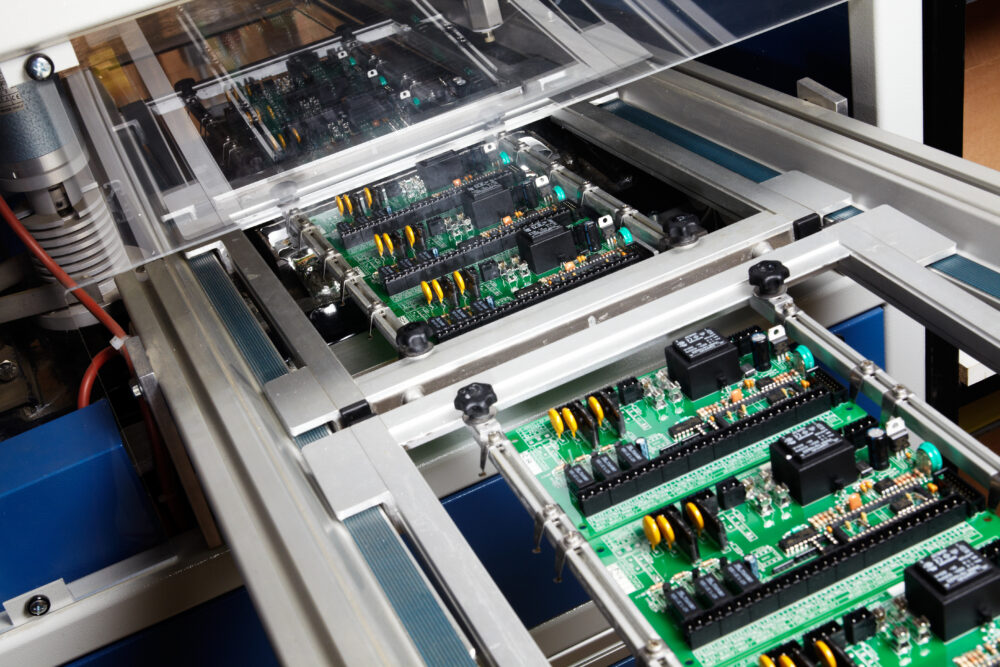
Reflow means that the solder is not applied directly with a tip, but as solder paste printed onto pads. The components are then placed and heated in a controlled manner in the oven until the paste melts and a solder joint is formed. The process is so widespread because it is highly automatable, enables high packing densities, and delivers reproducible quality.
How does a reflow oven work?
A reflow oven heats assembled circuit boards in a controlled manner in several temperature zones so that the solder paste melts and stable solder joints are formed on the SMD components
- Preheating
- Soak/temperature equalization
- Reflow/peak zone (solder melts)
- Cooling (solder joint solidifies)
Good to know: Reflow soldering systems are usually the heart of an SMD production line. After the assembly has been heated in the reflow oven, optical inspections, for example by AOI, follow depending on the quality requirements, and, if necessary, rework at the manual soldering station.
Comparison: Which soldering technique is suitable for which application?
The appropriate soldering technique is usually determined by a balance between technical requirements and cost-effectiveness:
Quantity and throughput
- Manual soldering: ideal for single pieces, small series, rework
- Selective/wave: good for medium to large series (THT/mixed)
- Reflow: strong for series production with SMD
Process stability and repeatability
- Manual soldering: varies depending on the operator
- Selective/wave: stable with a clean setup
- Reflow: very stable with good profile and material management
Investment costs
- Manual soldering: low
- Selective/wave: medium to high
- Reflow: high (line + peripherals), but scalable
Flexibility with variants
- Hand soldering: very high
- Selective: high (programmable)
- Wave soldering: rather low
- Reflow: high, but with setup effort (stencils, profiles)
Typical fault patterns
- Manual soldering: overheating, cold solder joints, too much/too little solder
- Wave: bridges, shadows, solder beads
- Selective: incomplete wetting with difficult geometry
- Reflow: tombstoning, voids, head-in-pillow
Deciding: Questions to ask yourself
Depending on the manufacturing environment, different approaches can lead to the optimal process. The following key questions will help you make your choice:
- What assemblies do you manufacture (SMD-only, THT-only, or mixed technology)?
- What quantities are realistic (today and in 12 months)?
- Where are the current bottlenecks?
- How important are documentation and traceability?
- How much rework is acceptable?
Rule of thumb for selection
- Hand soldering: when flexibility is more important than cycle time
- Selective soldering: when reproducible THT solder joints in mixed tech are required
- Wave soldering: when the focus is on robust series processes with suitable assemblies
- Reflow: when SMD series production, miniaturization, and automation dominate
Soldering technology as a process decision
In electronics manufacturing, soldering technology is rarely a single process that covers everything. Manual soldering remains important, for example for prototypes, rework, or small quantities. As soon as throughput and repeatability become more important, semi-automated processes become a logical addition.
The decisive factor is not so much the best technology, but rather the right process for your own manufacturing reality. Those who understand soldering technology as a modular principle make more informed decisions – not only technically, but also economically.
This might also interest you
-
Understanding Electronics
Relays explained: Basics, function, and application
Relays are one of the fundamental components of electrical engineering and automation. They switch, disconnect, and control electrical circuits—often inconspicuous, but technically indispensable. But what exactly is a re...
-
Manufacturing Industry
LOCTITE Thread Sealants: Hydrogen-Compatible Solutions for Preventing Hydrogen Gas Leaks
Hydrogen systems are demanding: Due to the extremely small molecular size of hydrogen, even the tiniest gaps in threaded connections can cause leaks, compromising safety, availability, and efficiency. Learn how hydrogen-...
-
Understanding Electronics
What is an Operational Amplifier – and how is it Used?
Operational amplifiers (Op-Amps or OPVs for short) are among the most important components in analog technology. When used correctly, they amplify, filter, or combine electrical signals – and thus perform tasks that you ...