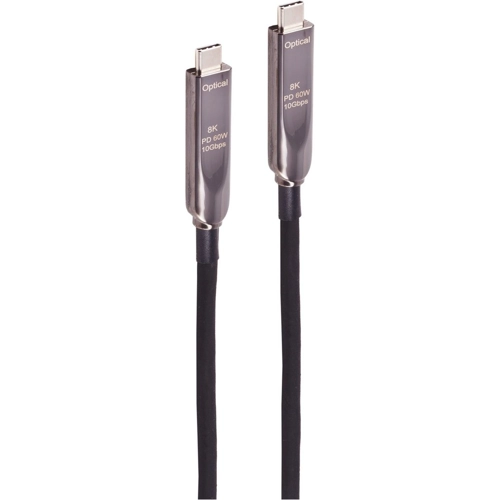
USB-C hybrid cable, BS30-43215, shiverpeaks
With a hybrid cable, part of the data is transmitted via an optical conductor (light signals) and another part via a copper line. The advantage of such an active-optical cable is the much longer transmission distance that can be achieved, as light signals are much less sensitive to electrical interference. Furthermore, a hybrid cable is lighter in weight and has a smaller diameter compared to a pure copper cable of comparable length. USB-C is becoming increasingly popular. In addition to a tablet or smartphone, the standard is also used as a video and charging cable for a workstation. USB 3.2 is limited to short distances. With a hybrid cable, longer distances are now possible. With this cable, you can, for example, connect your notebook to a USB-C monitor and charge your device simultaneously with up to 60W, if the monitor supports this function. Or connect your workstation to a USB 3.2 docking station and use features such as an SDXC card reader, a USB hub, an HDMI output, an RJ-45 LAN adapter, and much more. Not suitable for Thunderbolt 3/4/5 or USB4 docking stations.