
Semiconductor trends: Key technology for a connected future
Small but powerful: Semiconductors are miniature components, yet they form the foundation of our digital world. Whether in smartphones, household appliances, industrial equipment, or artificial intelligence, modern technological progress would be unthinkable without semiconductors. But what developments are currently driving the industry? And what role do semiconductors play in digitalization, AI, and innovation in the industry? We provide the information!
Table of contents
- Semiconductors as the engine of digital transformation
- Trend 1: Manufacturing – Optical lithography enables further miniaturization
- Trend 2: Semiconductor industry and artificial intelligence (AI)
- Trend 3: Data processing, advanced technologies, and market transformation
- Trend 4: Further development of the ecosystem and new challenges
- Outlook: Semiconductor technology in transition
Semiconductors as the engine of digital transformation
Semiconductors are now installed in almost every electronic device. They enable computing power, data processing, and networking — and thus central applications such as automation, AI, and autonomous driving.
The ever-growing demand for computing power has been challenging the semiconductor industry for decades. As early as 1965, Gordon Moore formulated Moore’s Law: the number of transistors on a chip, or the associated computing power, doubles approximately every two years. It is remarkable that this principle still holds true today – made possible by continuous technological innovations in chip manufacturing.
Discover our semiconductor range now!
Microchips are indispensable for future challenges – especially when it comes to digital transformation and the integration of AI applications. In addition, microchips are already indispensable in industry, as they form the basis of the Internet of Things (IoT). But also in the field of 5G technology and autonomous driving, all segments that are also constantly evolving and whose demands the chip industry must meet.
In other words, chips will have to become smaller and smaller and at the same time more and more powerful in the future.
Would you like to delve deeper into the topics?
Then feel free to take a look at our topic-specific articles on:
Trend 1: Manufacturing – Optical lithography enables further miniaturization
A key driver behind this development is optical lithography in semiconductor production. The wavelength of the light used to project the structures onto the wafers is crucial here. Newer methods such as EUV measure wavelengths of 13.5 nanometers – making the structures on the chip 5,000 times finer than a human hair.
High-NA EUV lithography goes one step further – this technology is expected to form the basis for even more refined chip structures in the coming years. And these are also necessary, as they are the only way to enable the performance required for AI applications.
Trend 2: Semiconductor industry and artificial intelligence (AI)
AI is also driving unprecedented growth in the semiconductor market. The current record sales are primarily due to investments in AI technologies. Data center servers, driven by AI developments, are important revenue drivers for the semiconductor industry.
Demand is particularly high for GPUs, logic ASSP/ASICs, DRAM (HBM), and power management ICs. The AI boom is likely to secure a growth window of around six years, potentially breaking the cyclical revenue patterns of the semiconductor industry to date.
Trend 3: Data processing, advanced technologies, and market transformation
The data processing segment is expected to account for more than 50% of total semiconductor revenue for the first time in 2026, driven by data centers and AI-related applications. Advances in high-performance computing (HPC), including silicon technologies ranging from 7 nm to 2 nm and specialty technologies such as silicon photonics and chiplets, will also drive revenue growth.
Spending on memory ICs will increase significantly, with a focus on expanding advanced DRAM and HBM capacities to meet AI-driven demand.
Trend 4: Further development of the ecosystem and new challenges
The automotive industry is evolving toward software-defined vehicles. This requires a new semiconductor ecosystem—with advanced, AI-enabled services, robust architectures, and reliable cybersecurity. The corresponding optimization of the necessary semiconductor components is indispensable in this area.
New technologies such as QLC-ESSD and edge AI are also gaining in importance in this context. At the same time, established solutions such as HDDs remain indispensable for large storage requirements – an indication of the necessary balance between innovation and existing infrastructure.
Challenges in supply chains, including potential infrastructure bottlenecks, delivery restrictions, and geopolitical risks, could affect growth in this area at any time.
Other challenges that will also play an increasingly important role in the future include:
- Material bottlenecks
- Energy requirements & sustainability
- Heat/performance limits
- Investment costs
- Shortage of skilled workers
Outlook: Semiconductor technology in transition
Semiconductor technology is constantly evolving: smaller structures, higher performance, lower energy requirements. These trends form the basis for innovations in industry, mobility, healthcare, and everyday life. Microchips are thus much more than technical components—they are a key technology for a networked, digital future that is increasingly shaped by artificial intelligence. Uncertainties remain regarding supply chains.
In this context, many are asking: Is another semiconductor shortage to be expected?
Fact is: Demand for electric vehicles, renewable energies, and factory automation is currently growing faster than available capacity. In view of this and the strong demand for power and analog semiconductors, the market is facing corresponding challenges. What will be needed in the future? Smart, agile, and coordinated factories and, along with them, reliable distributors.
At Bürklin, we always stand by our customers and continue to deliver high-quality semiconductor components quickly and reliably. And when the market doesn’t have what you need, we offer comprehensive and professional advice to develop adequate solutions or find alternatives.
This might also interest you
-
Electrical Manufacturing
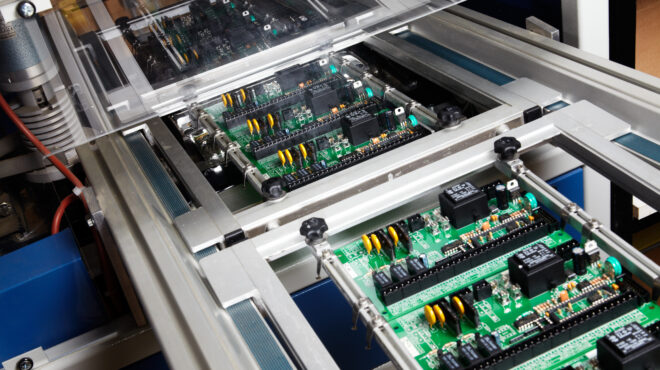
Soldering Technology in Manufacturing: From Manual Soldering Stations to Reflow Systems
Hand soldering, selective soldering, wave soldering, or reflow soldering: In practice, several soldering processes are often used in parallel today – within the same company, sometimes even on the same line. This is beca...
-
Understanding Electronics
What is an Operational Amplifier – and how is it Used?
Operational amplifiers (Op-Amps or OPVs for short) are among the most important components in analog technology. When used correctly, they amplify, filter, or combine electrical signals – and thus perform tasks that you ...
-

Electrical Manufacturing
Thermal management in electronics: Full performance without overheating
Power density and compactness define modern electronic designs. Where high power is generated in a very confined space, effective thermal management becomes a critical factor. With the right products for heat dissipation...