
E-mobility in transition: trends, technologies & measurement challenges
Electric drives are shaping the mobility of the future. Range-optimized battery performance, sophisticated power electronics, and precise sensor technology are driving a transformation that is rapidly gaining momentum. At the same time, the demands on efficiency, safety, and system integration are increasing. But which technologies will define the next generation of electric vehicles – and what role will measurement technology play in this?
Table of contents
- E-mobility today: Focus on efficiency, safety, and data
- Power electronics & battery systems
- Sensors as the basis for safety and autonomous driving
- Measurement technology
- Charging infrastructure & grid stability: efficiency meets everyday practicality
- Outlook: What will the e-mobility of tomorrow look like?
- The future of e-mobility
E-mobility today: Focus on efficiency, safety, and data
Electric mobility is increasingly evolving into a high-performance, data-driven system. Power electronics, battery management systems, charging infrastructure, and sensor technology, including for driver assistance functions, work closely together – networked, highly integrated, and in continuous use.
More on the basic technology behind e-mobility
Discover our vast product portfolio:
Power electronics & battery systems
The demands placed on modern electric vehicles are increasing – especially in the area of power electronics, which converts, regulates, and controls electrical energy in various subsystems. This applies, for example, to traction inverters, DC-DC converters, onboard and fast charging systems, and battery management systems.
The following are in demand:
- High efficiency & power density
- Faster charging times
- Lower power losses
- Miniaturization of components
- Improved thermal stability of components
High-quality components in this area control the energy flow between the battery, drive, and auxiliary consumers, ensure high efficiency in the overall system, and enable functions such as recuperation or fast charging.
Sensors as the basis for safety and autonomous driving
Modern electric vehicles are rolling sensor platforms. Cameras, radars, and motion sensors – they all provide data that influences safety, navigation, and efficiency. The reliable detection of dynamic driving conditions, environmental information, and system parameters is particularly important.
The challenge for developers: Sensors must be robust, temperature-stable, reliable over the long term, and resistant – because only then can systems deliver precise values for autonomous decisions.
Typical sensor applications:
- Driver assistance systems (ADAS)
- Environment perception for autonomous driving functions
- Battery and motor monitoring
- Temperature and vibration analysis
- Safety monitoring of high-voltage components
In the future, sensor technology will also become increasingly important in terms of developments in the field of autonomous driving.
Measurement technology
A central, often underestimated component of e-mobility is measurement technology – not only in vehicle development, but also in real-world operation. High-precision measurement systems record dynamic electrical parameters in real time and serve as the basis for efficiency, safety, and service life evaluations. For example, the correct recording of charging energy is a basic requirement for transparent billing at public charging stations.
According to German measurement and calibration law, measured variables such as kilowatt hours (kWh) charged must be recorded in a clear, traceable, and calibration-compliant manner so that users can be sure that consumption and costs are determined correctly – similar to established measurement procedures for combustion vehicles or in the energy grid.
But measurement technology goes far beyond the correct recording of charging processes: in the development and series production of electric vehicles, it plays a decisive role in testing batteries, power electronics, drive trains, and sensor systems.
Charging infrastructure & grid stability: efficiency meets everyday practicality
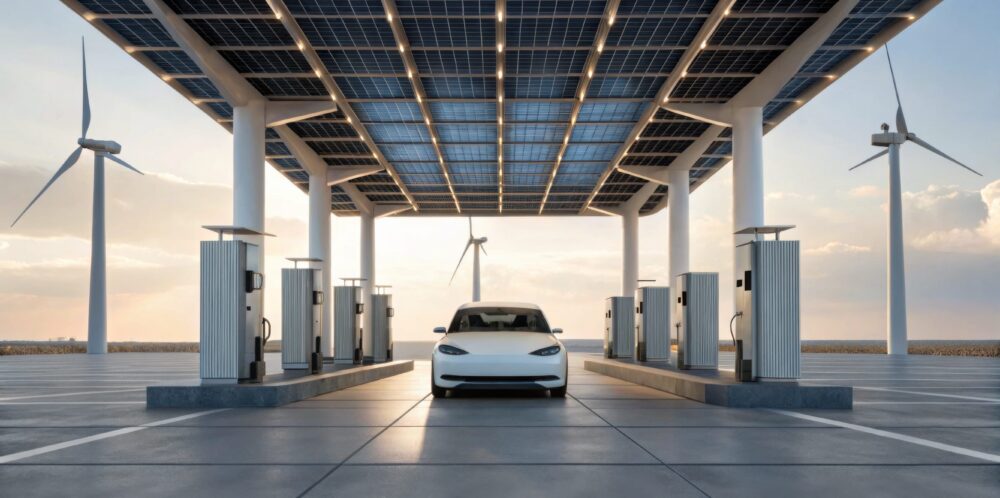
As the number of electric vehicles increases, the charging infrastructure is also changing. Fast charging stations operate with high currents. Up to 400 kW can be achieved at these DC stations. The car is fully charged again in 30 to 60 minutes.
The demands on components for these efficient charging processes are correspondingly high:
- Efficient load management
- Robust cables & wires
- Specialized connectors (CCS plug or CHAdeMO)
Battery modules with higher energy density, improved temperature management, and optimized cell chemistries are also increasingly coming into focus in order to further increase the range and performance of vehicles.
Our products for charging infrastructure:
Outlook: What will the e-mobility of tomorrow look like?
Electric mobility is still in its infancy. New materials, intelligent control systems, and networked systems will ensure that future generations of vehicles will be significantly more powerful, efficient, and safer on the road. At the same time, powertrains, energy storage systems, software, and sensor technology are increasingly merging into a holistic system.
Trends in electric mobility at a glance:
- Longer ranges thanks to optimized cell chemistry: new battery generations with higher energy density, more stable electrolytes, and improved charging cycles extend the range.
- Faster charging cycles: Fast-charging technologies, adapted cell architectures, and powerful power electronics enable quick and efficient refueling.
- More automation thanks to AI-supported sensor fusion: Data from radar, LiDAR, cameras, and other sensors is combined using AI to capture the environment, driving behavior, and system states even more precisely.
- Intelligent energy management in the vehicle and at home: The motor, battery, recuperation, and auxiliary consumers are dynamically coordinated to increase efficiency and minimize energy losses. Smart energy management systems ensure that power consumption is kept to a minimum, even when charging at home.
- Improved safety architecture through real-time data analysis: continuous monitoring of high-voltage components, battery status, and environmental parameters enables early fault detection and increases functional safety.
The future of e-mobility
Electric mobility is in a dynamic phase: longer ranges, faster charging processes, advanced sensor technology, and intelligent controls are fundamentally changing the requirements for systems and components.
Anyone developing, validating, or optimizing electric drives today needs robust measurement methods, reliable sensor technology, and powerful test systems. These form the basis for innovation, enable data-driven decisions, and create the conditions for tomorrow’s electric vehicles to be more efficient, safer, and more connected on the road.
With high-quality components and modern measurement technology, Bürklin supports companies on their path to sustainable, powerful, and future-oriented mobility. Discover the Bürklin range and let our experts advise you.
This might also interest you
-

Understanding Electronics
From Prototype to Series Production: Choosing the Right Microcontroller
In electronics development, choosing the right microcontroller is crucial, not only for the initial prototype but also for subsequent series production. From defining technological requirements and prototyping platforms ...
-

Understanding Electronics
How to Use Inductors Correctly: From Interference Suppression to Energy Storage
Inductors are among the most important passive components in modern circuits. They significantly influence their efficiency, EMC behavior, and thermal stability. Nevertheless, they are often selected “as an afterthought....
-

Understanding Electronics
Galvanic Isolation: Significance and Applications
Galvanic isolation is a key safety and functional principle in electrical engineering and electronics. It ensures that electrical circuits can communicate with one another without direct electrical contact. Especially in...