

Thermal management in electronics: Full performance without overheating
Power density and compactness define modern electronic designs. Where high power is generated in a very confined space, effective thermal management becomes a critical factor. With the right products for heat dissipation, you can increase the reliability and service life of your projects and designs. How to find the right products for your design is explained in this blog post.
Table of contents
- The challenge: Controlling heat efficiently
- What does thermal management in electronics mean?
- Selecting thermal interface materials for thermal management
- Tailored solutions for every application from Würth Elektronik
- Implementing thermal management reliably with Bürklin
- Frequently asked questions thermal management
The challenge: Controlling heat efficiently
In the fast‑paced world of electronics development, time is a scarce resource. Overheating leads to throttling of performance or, in the worst case, to system failure. Heat must therefore be transferred efficiently from the source (e.g. processor or power semiconductor) to the heat sink or enclosure. Therefore, insulating air gaps must be eliminated and thermal resistances minimized.
Design engineers often face complex questions:
- How can even large gap dimensions be reliably bridged while ensuring electrical insulation?
- When is it better to use a phase‑change thermal material instead of conventional thermal grease?
- How can accurate simulation models help solve thermal issues already during the design phase?
What does thermal management in electronics mean?

Thermal management comprises all methods used to control the removal of excess heat generated by electronic components. The goal is to create a defined path for the thermal energy and thus ensure the reliability and service life of devices.
Robust thermal management is the key to avoiding performance losses and actively reducing electronic waste caused by premature failures. There are two main strategies for this:
Gap filling
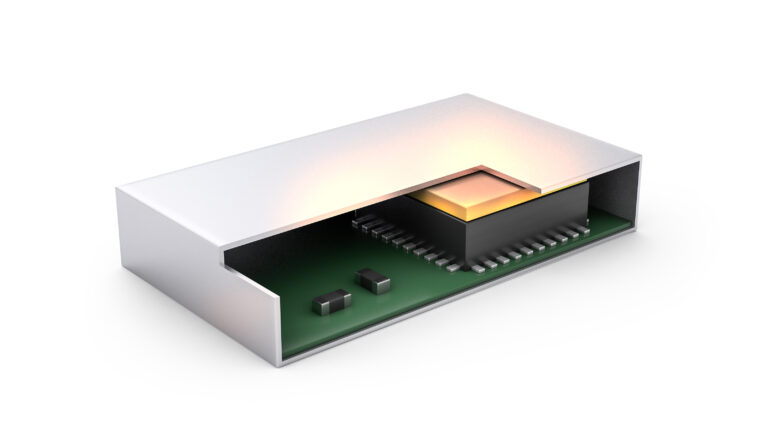
This involves eliminating insulating air gaps between the heat source and the cooling element. Thermal interface materials fill these gaps, which can range from microscopic voids to several millimeters, and establish a direct thermal contact.
Heat spreading
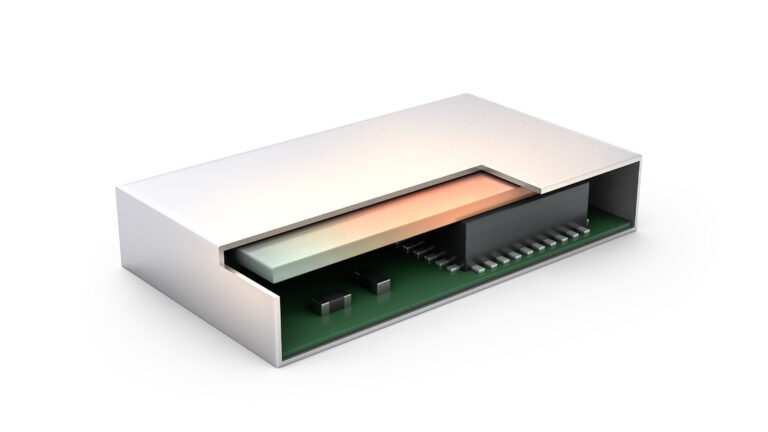
Instead of removing heat only at a single point, it is distributed over a larger area in the horizontal plane. This makes it possible to use heat sinks that are larger than the heat source itself more efficiently and helps prevent local overheating (hotspots).
Selecting thermal interface materials for thermal management
The efficiency of thermal management stands and falls with the choice of the right thermal interface material (TIM). It is not just about creating a connection, but about precisely addressing the specific requirements of the application. The right TIM optimizes heat transfer, prevents critical heat build‑up and is therefore the key to the reliability of your system.
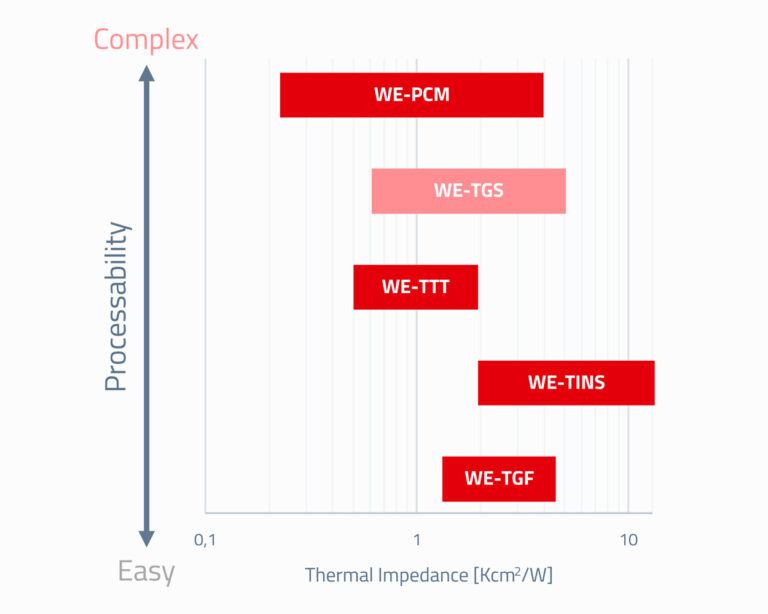
To select the right thermal interface material, you can use the following criteria as a guide:
- Large gaps & insulation: Use silicone elastomer pads when greater tolerances have to be compensated and electrical insulation is required at the same time.
- Maximum conductivity: Choose phase‑change materials (PCM) when high thermal conductivity and long‑term stability are required.
- Assembly & retention: Thermally conductive adhesive tapes are ideal for mechanically fixing components with moderate heat dissipation requirements while providing a thermal connection.
- Flexibility & spreading: Heat spreaders made of synthetic graphite come into their own when high in‑plane thermal conductivity needs to be combined with mechanical flexibility.
By matching the material precisely to the application, you not only improve thermal performance but also actively extend the service life of your devices.
Tailored solutions for every application from Würth Elektronik
The Würth Elektronik portfolio covers a wide range of applications to keep your components cool.
H3: Gap filling in electronics with thermal pads
To compensate for manufacturing tolerances and air gaps between the component and the heat sink, gap filler pads of the WE‑TGF series are an excellent choice.
- Flexibility: They are available in thicknesses from 0.5 to 18 mm.
- Performance: Depending on the version, their thermal conductivity ranges from 1 to 6 W/mK.
- Insulation: At the same time, they offer high electrical insulation and are self‑adhesive due to silicone oil, which simplifies assembly.
For applications with uneven contact surfaces, the graphite‑coated foam profile of the WE‑TGFG product series provides a very good alternative. These products combine the thermal conductivity of graphite with the compressibility of foam, which makes them particularly suitable for uneven contact surfaces.

Phase‑change material instead of thermal grease
An innovative alternative to conventional thermal grease is the phase‑change thermal material (WE‑PCM).
- Functionality: It is solid at room temperature and only liquefies at operating temperature. This ensures perfect wetting of the surfaces.
- Advantage: In contrast to thermal grease, there is no “pump‑out effect”. The material remains permanently where it is needed.
- Handling: It is cleaner and easier to process.
Spreading heat and avoiding hotspots
When localized heat needs to be quickly distributed over a larger area, heat spreaders made of synthetic graphite (WE‑TGS) are the solution. Their in‑plane thermal conductivity clearly exceeds that of copper or aluminum. They are lightweight, flexible and ideal for space‑constrained applications such as mobile devices to effectively eliminate hotspots.
Mounting and insulation
For mechanical attachment of heat sinks without screws or clips, the thermal transfer tape (WE‑TTT) is an excellent option. It securely fixes components and conducts heat at the same time. Where high dielectric strength must be ensured under high contact pressure, thermally conductive insulating films (WE‑TINS) are the right choice. They withstand pressures up to 68 N/cm².
Implementing thermal management reliably with Bürklin
Today, thermal management often determines whether a design remains stable under real load profiles or throttles early or even fails. If you want to reliably bridge gap dimensions while providing electrical insulation, gap filler pads such as the WE‑TGF series from Würth Elektronik offer a practical, installation‑friendly solution.
For more advanced requirements such as phase‑change materials, synthetic graphite heat spreaders or thermal transfer tapes, it is worth taking a closer look at the complete WE portfolio.
At Bürklin you will find suitable thermal management products for your application, with clear technical data for quick preselection and the option to configure components precisely for your project.
Frequently asked questions thermal management
What is thermal management in electronics?
Thermal management in electronics comprises all measures that remove or distribute dissipated heat from components in a controlled way so that they operate within permissible temperature limits and failures due to overheating are avoided.
Why is thermal management so important at high power density?
As power density increases, more heat is generated on a smaller area. Without proper thermal dissipation, hotspots can occur that lead to performance throttling, parameter drift or premature failure.
What is a thermal interface material and what is it used for?
A thermal interface material, or TIM, improves the thermal contact between the heat source and the heat sink or enclosure by reducing air gaps and lowering thermal resistance.
When are gap filler pads useful?
Gap filler pads are useful when gap dimensions and tolerances need to be compensated and, at the same time, an electrically insulating and installation‑friendly solution is required, for example between a component and a heat sink.
Thermal grease or phase‑change material – which is better and when?
Thermal grease is often suitable for conventional assembly processes but can lose performance over time due to pump‑out effects. Phase‑change materials such as WE‑PCM wet the surfaces very well at operating temperature and usually remain more dimensionally stable within the interface.
What does heat spreading mean and when does it help?
Heat spreading means distributing heat in the plane to alleviate localized hotspots. This is particularly helpful when the heat source is smaller than the available cooling area or when very flat, space‑constrained designs are required.
This might also interest you
-
Understanding Electronics
Relays explained: Basics, function, and application
Relays are one of the fundamental components of electrical engineering and automation. They switch, disconnect, and control electrical circuits—often inconspicuous, but technically indispensable. But what exactly is a re...
-
Manufacturing Industry
LOCTITE Thread Sealants: Hydrogen-Compatible Solutions for Preventing Hydrogen Gas Leaks
Hydrogen systems are demanding: Due to the extremely small molecular size of hydrogen, even the tiniest gaps in threaded connections can cause leaks, compromising safety, availability, and efficiency. Learn how hydrogen-...
-
Electrical Manufacturing
Soldering Technology in Manufacturing: From Manual Soldering Stations to Reflow Systems
Hand soldering, selective soldering, wave soldering, or reflow soldering: In practice, several soldering processes are often used in parallel today – within the same company, sometimes even on the same line. This is beca...