
Power Supply in the Control Cabinet: Selection, Sizing, and Fuse Protection
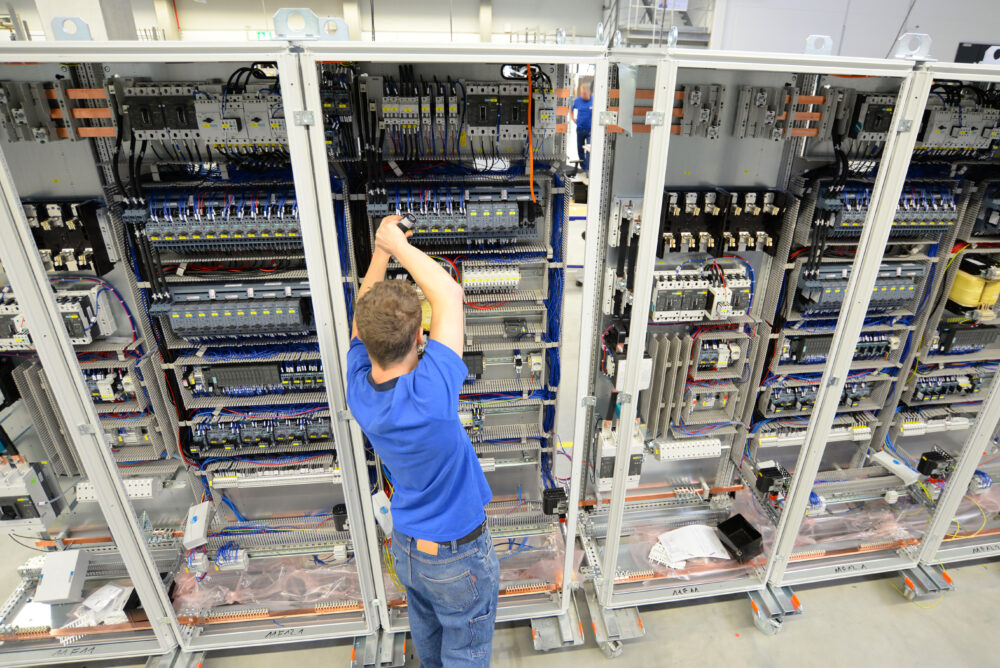
A stable power supply is the backbone of every industrial facility. The control cabinet is where power distribution, control systems, and protective mechanisms converge. It is here that the reliability of control systems and the smooth operation of production processes are determined. Design errors have immediate consequences: voltage sags lead to control system resets, and thermal overload shortens the service life of components. Thorough planning of the power supply therefore involves much more than simply selecting a suitable power supply unit. This article explains what matters most when it comes to power supply in the control cabinet: from selecting and sizing appropriate power supply units to protection and redundancy concepts.
Table of contents
- What requirements must a power supply in a control cabinet meet?
- What Matters When Selecting a Power Supply?
- Hold-up Time and Power Boost: Two Important Stability Factors
- How does power distribution work in the control cabinet?
- Fuse Protection and Protection Concepts
- Redundancy and Availability
- What are some typical power supply issues in control cabinets?
- Selectivity in 24-V Systems Explained Simply
- Planning Reliable Power Supply Concepts
What requirements must a power supply in a control cabinet meet?
Industrial environments place high demands on the power supply. Temperature ranges from 0 to over 50 degrees Celsius, dust exposure, vibrations, and electromagnetic interference all affect operation. Power supplies in control cabinets must therefore operate reliably and deliver a constant output voltage.
Voltage stability and sufficient power reserves are particularly crucial in the 24-V DC range, which has become the industry standard. Controllers, HMI systems, sensors, and actuators are sensitive to undervoltage or voltage spikes. At the same time, inrush currents or load changes can cause high current spikes for short periods.
High efficiency reduces power loss and thus heat generation in the control cabinet. This has a positive effect on the cooling design and the service life of all installed components. Equally important are a compact design, DIN rail mountability, and compliance with relevant standards, such as EN 60204-1 (Electrical Equipment of Machines) and the applicable European machinery regulations.
What Matters When Selecting a Power Supply?
Selecting the right power supply is the first step toward a stable power supply.
Power Sizing
The rated power should not exactly match the calculated load requirement. A power reserve of 20 to 30 percent provides a safety margin for load peaks or future expansions. Inrush currents from motors, relays, or capacitive loads must also be taken into account.
Input Voltage
Depending on the system, single-phase or three-phase power supplies are used. Wide-range inputs increase flexibility in international applications or under fluctuating mains conditions.
Efficiency and Power Loss
High efficiency reduces heat generation in the control cabinet. This directly affects the overall thermal design, especially in densely packed installations. Less waste heat means lower cooling requirements and greater operational reliability.
Design and Integration
Power supplies for control cabinets are typically designed for DIN rails. In addition to width, the ability to connect units in parallel or integrate redundancy modules also plays a role.
Power Supply Sizing Checklist
- Calculate the total load of all consumers
- Take inrush currents into account
- Allow for a power reserve of 20 to 30%
- Consider ambient temperature and derating
- Check efficiency and power dissipation
- Consider the system’s scalability
Hold-up Time and Power Boost: Two Important Stability Factors
Hold-up Time
The hold-up time indicates how long a power supply maintains its output voltage when the input voltage is briefly interrupted. Typical values range from 10 to 30 milliseconds. It prevents control system resets during brief power outages.
Power Boost (Top Boost)
Power Boost describes a power supply’s ability to briefly deliver a current higher than its rated output. This is important for inrush currents, load peaks, and the safe triggering of protective devices in a 24-V system.
Good to know: While the hold-up time compensates for power disturbances on the input side, Power Boost ensures stability during load peaks on the output side. Both functions increase the availability of industrial systems.
How does power distribution work in the control cabinet?
After converting AC to DC, the energy is distributed in a structured manner. A clear separation of power and control circuits improves clarity and reduces susceptibility to interference.
In the 24-V range, distribution modules or busbars are often used to efficiently connect multiple loads. Proper potential separation prevents unwanted interference between individual circuits.
Well-designed secondary distribution is crucial, especially in complex systems. It enables targeted protection of individual loads and simplifies maintenance and fault diagnosis.
Fuse Protection and Protection Concepts
A stable power supply does not end with the power supply unit. A coordinated protection concept is just as important.
Circuit breakers primarily protect the wiring against overloads and short circuits. In the 24-V DC range, however, conventional thermomagnetic circuit breakers often reach their limits, as the tripping behavior at low voltages differs from that in the AC range.
Electronic fuses offer advantages in this context. They precisely detect overcurrents, trip selectively, and enable rapid restoration of power. In addition, they often provide diagnostic information that can be integrated into modern control systems.
Another important component is surge protection. Transient voltage spikes can occur, particularly with long cable runs or externally connected components, which can damage sensitive electronics.
Redundancy and Availability
In many industrial applications, high system availability is crucial. Downtime results in significant costs. Redundant power supply designs significantly increase reliability.
Typical configurations therefore include two power supplies connected in parallel with ORing or redundancy modules. If one power supply fails, the second takes over the power supply without interruption. In combination with monitoring functions, faults can be detected early and maintenance measures planned.
Redundancy is particularly relevant in critical areas such as the process industry, energy supply, or automated production lines.
What are some typical power supply issues in control cabinets?
In practice, problems often arise due to power supplies that are undersized or lack sufficient power reserves. Inadequate heat dissipation can also significantly shorten the service life.
Another common error is a lack of selectivity in the 24-V distribution system. If a short circuit causes the entire power supply to shut down, troubleshooting becomes unnecessarily difficult. Structured protection of individual circuits significantly increases operational reliability.
Selectivity in 24-V Systems Explained Simply
Selectivity means that, in the event of a fault, only the affected circuit is shut down—not the entire system.
This is achieved through:
- tiered protection concepts
- appropriate trip characteristics
- electronic fuse systems
The goal is rapid fault localization with minimal production downtime.
Planning Reliable Power Supply Concepts
A reliable power supply in a control cabinet is not achieved by selecting a single high-performance power supply unit, but rather through a coordinated overall concept. Power sizing, structured 24-V distribution, selective fusing, and, where necessary, redundancy solutions all work together to ensure the operational reliability of the system.
The key is finding the right combination of power supplies, protection and distribution components, and supplementary modules.
Bürklin supports you with a wide range of industrial-grade power supplies, protection and distribution components, and supplementary system solutions to help you implement customized power supply concepts with precision—from compact control cabinets to complex production facilities.
This might also interest you
-
Energy efficiency
Light with precision: RGB LEDs with integrated control circuit
Additive color mixing with red, green and blue LEDs, grouped into pixels, opened up new possibilities for displays and lighting designs. When the first modules with integrated circuits (ICs) appeared around ten years ago...
-
Measurement technology
Understanding Power Management ICs: Key Components of Modern Electronics
Efficiently distributing, regulating, and monitoring power is one of the central tasks of electronic systems today. Power density, feature sets, and reliability requirements are constantly increasing. At the same time, p...
-

Measurement technology
Reliable Railway Electronics: Choosing the Right Semiconductors for Maximum Safety and L...
Modern train electronics set the highest standards for reliability and safety. Continuous operation must be guaranteed even under extreme conditions. The selection of the right electronic components is far more than a de...